

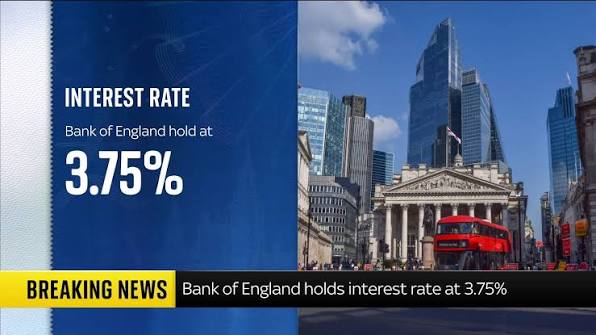

The Bank of England interest rate is 3.75% as of 25 August 2026, after policymakers voted to leave Bank Rate unchanged for a fifth consecutive meeting.
The decision is becoming more significant for households because UK inflation has started rising again. Consumer price inflation reached 2.9% in July, up from 2.6% in June, while the Bank has warned that inflation could rise further later this year.
For borrowers, the picture is mixed. Tracker and some variable-rate mortgages remain exposed to Bank Rate, while fixed mortgage rates are influenced heavily by financial-market expectations. For savers, competitive accounts can still offer returns above inflation, although average savings rates are considerably lower than the best headline deals.
The next Bank of England interest-rate decision is scheduled for 17 September 2026.
Key Facts
| Fact | Latest position |
|---|---|
| Bank Rate | 3.75% |
| Latest decision | Held on 30 July 2026 |
| MPC vote | 6–3 to hold |
| Members favouring 4% | 3 |
| UK CPI inflation | 2.9% in July |
| UK inflation target | 2% |
| Average new mortgage rate | 5.59% at start of August |
| Average two-year fixed mortgage | 5.63% at start of August |
| Average five-year fixed mortgage | 5.66% at start of August |
| Average new savings rate | 3.63% AER on 19 August |
| Next Bank Rate decision | 17 September 2026 |
Sources: Bank of England, ONS and Moneyfacts.
Table of Contents
- What is the Bank of England interest rate?
- Why is Bank Rate still 3.75%?
- What does the rate mean for mortgage borrowers?
- What happens to fixed-rate mortgages?
- What does Bank Rate mean for savers?
- Why are mortgage rates different from Bank Rate?
- What does the rate mean for businesses?
- What does it mean for Ireland?
- What happens next?
- What should borrowers and savers watch?
What Is the Bank of England Interest Rate?
The Bank of England’s Bank Rate is the UK’s core policy interest rate.
It influences the rates commercial banks and other financial institutions charge borrowers and pay to savers. However, Bank Rate does not automatically determine every mortgage, loan or savings rate.
For borrowers, higher rates generally mean higher financing costs.
For savers, higher rates can mean greater interest income.
The Bank uses interest rates primarily to help control inflation. Higher rates can discourage borrowing and spending, reducing demand in the economy and helping to slow price growth.
Why Is Bank Rate Still 3.75%?
The Monetary Policy Committee voted 6–3 to hold Bank Rate at 3.75% at its July meeting.
Three members preferred an increase to 4%.
The decision reflects a difficult inflation environment.
UK CPI inflation had fallen to 2.6% before the July decision, but the Bank expected inflation to rise later in 2026 as higher energy costs passed through the economy.
That increase has now started to appear in the official data.
The ONS reported CPI inflation of 2.9% in July, while core CPI remained at 2.6% and services inflation eased to 3.4%.
The Bank therefore faces a difficult balance.
Cutting rates too quickly could add demand to an economy where inflation is already above target.
Keeping rates high for too long could put additional pressure on households and businesses.
What Does the Rate Mean for Mortgage Borrowers?
The effect depends heavily on the type of mortgage.
Tracker mortgages
A tracker mortgage is normally linked directly to an external benchmark, often Bank Rate.
If Bank Rate rises, the mortgage rate normally rises according to the terms of the mortgage.
If Bank Rate falls, the mortgage rate can fall.
The FCA defines a Bank of England base-rate tracker as a mortgage where the rate is guaranteed to move in line with Bank Rate.
Standard variable rate mortgages
SVRs work differently.
The lender determines the rate, meaning it does not automatically have to move by the same amount as Bank Rate.
MoneyHelper describes an SVR as a rate set by the mortgage lender rather than directly linked to Bank Rate.
Fixed-rate mortgages
A fixed-rate mortgage protects borrowers from changes in Bank Rate during the fixed period.
But protection does not last forever.
When the fixed period ends, borrowers normally need to move onto another deal or risk moving to the lender’s reversion rate, which is often an SVR.
Fixed Mortgage Rates Are Telling a Different Story
One of the most important points for borrowers is that fixed mortgage rates can rise even when Bank Rate does not.
Moneyfacts reported that the average new mortgage rate increased from 5.47% in July to 5.59% in August.
The average two-year fixed rate rose to 5.63%, while the average five-year fixed rate reached 5.66%.
Moneyfacts’ data show that mortgage pricing also varies substantially according to loan-to-value ratio.
At the beginning of August:
| LTV | Average 2-year fixed | Average 5-year fixed |
|---|---|---|
| 60% | 5.17% | 5.46% |
| 75% | 5.51% | 5.63% |
| 85% | 5.68% | 5.64% |
| 95% | 6.20% | 6.08% |
This demonstrates why there is no single mortgage rate applicable to every borrower.
Why Are Mortgage Rates Different From Bank Rate?
Fixed mortgage rates depend on more than the central bank’s current policy rate.
Lenders consider:
- wholesale funding costs
- swap rates
- market expectations
- borrower risk
- loan-to-value ratio
- competition between lenders
- operating costs
- expected future interest rates
The Bank of England reported that financial conditions had tightened significantly and that higher short-term market interest rates had fed through into household borrowing costs.
This is why consumers should not assume that a future Bank Rate cut will automatically produce an equivalent reduction in every fixed mortgage.
What Does Bank Rate Mean for Savers?
Savers face almost the opposite situation.
Higher interest rates can make saving more attractive because banks have greater incentive to compete for deposits.
But the headline Bank Rate should not be confused with the rate available on an individual savings account.
Moneyfacts reported an average new savings rate of 3.63% AER on 19 August 2026.
Meanwhile, some competitive products were offering considerably higher rates.
Moneyfacts’ August market data showed easy-access accounts around 5% AER and regular savings products reaching 8%, although these products can include bonuses, eligibility conditions or deposit restrictions.
The practical lesson for savers is simple:
The rate you actually earn depends on the account you hold, not simply on Bank Rate.
Should Savers Lock In a Fixed Rate?
That depends on expectations, the need for access to cash and the terms of the account.
Fixed-rate savings products provide certainty because the interest rate is agreed for a specified period.
MoneyHelper notes that fixed-rate savings bonds guarantee a set interest rate over their agreed term.
For someone who needs immediate access to their money, an easy-access account may be more appropriate.
For someone who does not need the cash during the fixed period, locking in a competitive rate can provide greater certainty.
The key issue is that future Bank Rate movements cannot be known with certainty.
What Does the Bank Rate Mean for Businesses?
The impact extends beyond household mortgages.
Higher borrowing costs can affect:
- business loans
- overdrafts
- investment decisions
- property development
- working capital
- mergers and acquisitions
- startup financing
- SME expansion
The Bank of England said business investment grew by 0.9% in the first quarter of 2026 but expected investment to soften over coming quarters as uncertainty and financing costs weighed on investment intentions.
This creates an important connection between monetary policy and the wider economy.
If companies face higher financing costs, some may postpone expansion or investment.
If borrowing becomes cheaper, businesses may have greater capacity to invest.
What Does It Mean for UK Households?
The effect is uneven.
Borrowers
Borrowers remain vulnerable to higher rates, particularly if:
- they have a tracker mortgage
- they are on an SVR
- their fixed-rate deal is ending
- they need a new mortgage
- they carry variable-rate debt
Savers
Savers can benefit from:
- competitive savings accounts
- fixed-rate bonds
- cash ISAs
- regular saver products
But they need to compare the actual rate, conditions and access requirements.
Homebuyers
Potential buyers face a more complicated environment.
A stable Bank Rate does not guarantee falling fixed mortgage rates.
Moneyfacts’ data show that mortgage rates moved higher in August even though Bank Rate remained at 3.75%.
What Does It Mean for Ireland?
Irish borrowers should not interpret the Bank of England’s 3.75% rate as Ireland’s interest rate.
Ireland is part of the euro area and monetary policy is set by the ECB.
The ECB kept its deposit facility rate at 2.25% in July 2026.
The Central Bank of Ireland reported that the weighted average rate on new Irish mortgage agreements was 3.49% at the end of June 2026.
For Irish readers, the Bank of England decision matters mainly through economic and financial connections between Britain and Ireland.
These include:
- sterling/euro exchange rates
- UK demand for Irish exports
- UK-Ireland trade
- Irish companies operating in Britain
- UK investments held by Irish investors
- cross-border financial services
Ireland’s own inflation rate was 3.4% in July 2026, according to the CSO.
That provides useful context for readers comparing monetary conditions on both sides of the Irish Sea.
What Are Markets Expecting Next?
The outlook is uncertain.
A Reuters poll conducted between 13 and 18 August found that nearly 90% of 64 economists expected the Bank of England to keep rates unchanged for the rest of 2026. However, market pricing and economist expectations were not completely aligned, with some market participants still seeing a possibility of a rate increase.
This distinction matters.
Forecasts are not decisions.
The MPC will respond to incoming data, particularly:
- inflation
- wages
- employment
- energy prices
- services inflation
- economic growth
- household spending
- financial conditions
The next official decision is due on 17 September 2026.
What Should Borrowers Watch?
Borrowers should pay particular attention to:
- The date their fixed mortgage ends.
- Their lender’s current reversion rate.
- Available remortgage rates.
- Bank Rate expectations.
- Swap-rate movements.
- Inflation.
- Energy prices.
- Their monthly affordability buffer.
Anyone struggling with mortgage payments should contact their lender early rather than waiting until payments are missed. The FCA specifically advises borrowers worried about repayments to contact their lender as soon as possible.
What Should Savers Watch?
Savers should monitor:
- AER rather than simply the headline rate.
- Introductory bonuses.
- Bonus expiry dates.
- Withdrawal restrictions.
- Minimum deposits.
- Fixed-rate terms.
- ISA allowances and tax considerations.
- Whether their existing account remains competitive.
A Bank Rate hold does not mean every savings account will keep the same rate.
Banks can change savings rates for competitive and funding reasons independently of the exact movement in Bank Rate. The Bank of England itself notes that lending and savings rates are influenced by factors beyond Bank Rate.
What Happens Next?
The next major milestone is the 17 September 2026 Bank of England decision.
Before then, markets and policymakers will receive additional information about inflation, wages, economic activity and financial conditions.
The key question will be whether July’s rise in inflation proves temporary or becomes a more persistent problem.
For borrowers, that could determine whether mortgage pricing becomes more stable or moves higher.
For savers, it could influence whether competitive savings rates remain available.
For businesses and investors, it will help shape expectations about financing costs and economic growth.
The Bottom Line
The Bank of England’s 3.75% Bank Rate is not simply a number for economists and financial markets.
It affects household borrowing costs, mortgage decisions, savings returns and business investment.
The latest data show why the Bank is cautious. UK inflation has risen to 2.9%, while mortgage rates have also moved higher despite Bank Rate remaining unchanged. At the same time, competitive savings accounts continue to offer returns above the Bank Rate.
For UK households, the most important issue is therefore not simply whether Bank Rate rises or falls.
It is how quickly different financial products respond — and what that means for the money entering and leaving a household budget.
For Irish readers, the crucial distinction is that the ECB sets monetary policy for Ireland. The Bank of England rate matters to Ireland mainly through trade, sterling, investment and cross-border financial exposure.
The next major test comes on 17 September.
KEY FACTS & KEY TAKEAWAYS
Key Facts
- Bank Rate: 3.75%
- Latest decision: 30 July 2026
- Vote: 6–3 hold
- Three MPC members preferred 4%.
- UK CPI inflation: 2.9% in July
- UK core CPI: 2.6%
- UK services inflation: 3.4%
- Average new mortgage rate: 5.59%
- Average two-year fixed mortgage: 5.63%
- Average five-year fixed mortgage: 5.66%
- Average new savings rate: 3.63% AER
- Next BoE decision: 17 September 2026.
Key Takeaways
- Bank Rate remains 3.75%.
- The Bank is concerned about renewed inflation pressure.
- Three MPC members wanted a rate increase in July.
- Fixed mortgage rates are not determined solely by Bank Rate.
- Tracker mortgages are directly linked to Bank Rate according to their terms.
- Savers can still find competitive rates.
- The average savings rate is below the best headline offers.
- Around five million households could face higher mortgage repayments by the end of 2028 under the Bank’s July projection.
- Ireland uses ECB monetary policy, not Bank of England monetary policy.
- The next UK interest-rate decision is 17 September.
FAQ SECTION
What is the Bank of England interest rate in August 2026?
The Bank of England’s Bank Rate is 3.75% as of 25 August 2026. The rate was held at 3.75% at the July MPC meeting.
Will the Bank of England raise interest rates in September 2026?
No decision has been made. The next scheduled MPC decision is 17 September 2026. Forecasts remain uncertain because inflation and energy prices are changing.
Will mortgage rates fall if Bank Rate falls?
Not necessarily by the same amount. Tracker mortgages are directly linked to Bank Rate, but fixed mortgage rates are influenced by market expectations, swap rates and lender pricing.
What happens to a tracker mortgage when Bank Rate changes?
A tracker mortgage normally moves in line with its reference rate, often Bank Rate. The exact timing and margin depend on the mortgage contract.
What happens when a fixed mortgage ends?
If a borrower does not arrange a new deal, they will normally move onto the lender’s reversion rate, often an SVR. This rate can be higher than the previous fixed rate.
Are savings rates still above inflation?
Some are. UK CPI inflation was 2.9% in July, while Moneyfacts’ average new savings rate was approximately 3.63% AER on 19 August. Individual products can offer considerably more or less.
Does the Bank of England interest rate affect Ireland?
Not directly. Ireland uses the euro and its monetary policy is determined by the ECB. The Bank of England rate can nevertheless affect Ireland through sterling, UK trade, investment and cross-border financial activity.
What is the next Bank of England interest-rate decision?
The next scheduled decision is 17 September 2026.
Why are fixed mortgage rates different from Bank Rate?
Fixed mortgage rates reflect market funding costs and expectations about future interest rates as well as lender competition and borrower risk. They therefore do not have to move one-for-one with Bank Rate.
